
Sir Michael Craig-Martin’s Umbrella (2026) is a bespoke charity commission for Paul Smith’s Foundation, created to fund the launch of a new visual artist residency in central London. With support from Cristea Roberts Gallery and Jealous Gallery, Craig-Martin is donating 100% of the proceeds from the edition to the Foundation. Established by Sir Paul Smith to improve the business skills of creative people, the Foundation will use the funds to establish a residency combining subsidised studio space with a bespoke programme of training in cashflow, pricing, selling and professional development.
The umbrella is a motif to which Craig-Martin has returned throughout his practice. In Umbrella, the familiar object is rendered through the precise line and unexpected colour that define his visual language. Presented in three colourways, the edition can be purchased individually or as a complete set.
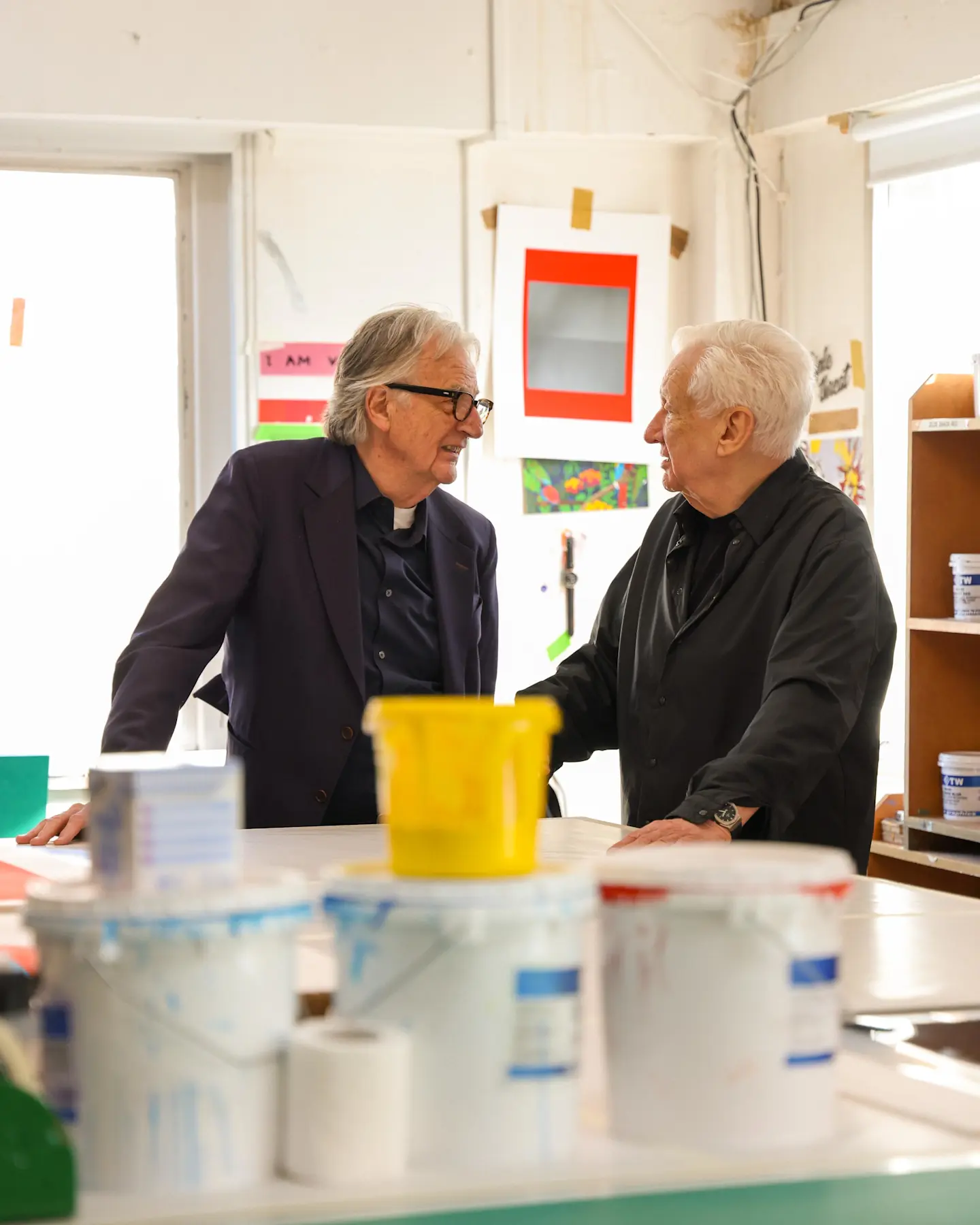
As part of this commission, we sat down with Sir Michael at Cristea Roberts Gallery to talk about his inspirations, teaching at Goldsmith's and his hope for creative education today.
Please could you introduce yourself?
I'm Michael Craig Martin. Great. And so, Sir Michael, you've made a bespoke commission umbrella for Paul Smiths foundation.
How did the process of creating this new commission come to be?
Well, Paul asked me to to do something to support his charity, to help younger people, creatives.
And so we we discussed it and decided on a set of, of prints. And then it was a question really for me about deciding what the subject would be. I thought it should be a single image, a picture for the image, for the for the prints. And I went through various possibilities. I wanted to have something that was close to what he does without being exactly what he does.
I didn't want to be like an advertisement, but I wanted it to have an association, and it seemed like the umbrella was the perfect object to do that with.
You’ve been teaching at Goldsmith’s for decades, tutoring some of the most prolific living artists. Why is teaching so important to you?
Well, in the beginning, I started teaching because it was a way of making a living, and but I didn't make any money from my work. And it was the nice thing about teaching in an art school was that you stayed very close to the subject without. It wasn't like having a job, doing something else, something completely different. And at the same time it is gave you the the kind of time that you needed in order to pursue your own work. I enjoyed teaching when I was doing it. I think if you're going to do anything, it's a good idea to try to enjoy it. And it worked out well for me.
I learned a lot from from teaching. I learned a lot about art, and I learned a lot about myself. One of the things that I discovered was, sometimes it's much easier to tell somebody else what it is that you really want to tell yourself. And if you just listen to what you're saying. Sometimes you can learn something nice. Thank you.
What was the most significant shift in art education from when you studied to now?
It's a very difficult question about how how education has changed. My education was in America, which American education tends to be much more prescriptive. British education is much more open, much more liberal, puts much more emphasis on individual individual pursuit.
For some people, one system is better than the other. The very open, the openness of British education suited my way of thinking and my my idea about how much to teach. Okay, brilliant.
Your use of colour is instantly recognisable, how did you begin introducing colour within your work?
I there was no color really, in my work from at least 30 or 40 years. And then basically, color is quite a difficult thing to address. It's a bit frightening, and I kind of stumbled on a way to approach it, and that to get it in, in a sense, to get over my fear and which which was essentially when I realized that you could make anything, any color you wanted, it didn't matter. Yeah.
Could you tell us about your relationship with Paul?
me and Paul. No more or less the same generation. We go back a long way. I've known him from long ago, and it's been, you know, it's been very interesting and encouraging to watch his success over, over many years. And I think because we come from the same kind of generation, our fundamental ideas about society, about, say, about teaching, about things like that are really very similar. So it's an easy thing for me to feel comfortable with him.
Money raised from the prints are going to be used to launch a business developemnt program and a studio program for visual artists, why in your opinion are business ksills so important to an artists’ practice?
I think obviously the most important thing in the creative practice is the creative aspect, and that's really what a principal thing that an education should provide. On the other hand, as soon as you move out of the school into the world, there are a lot of very practical things you have to deal with, and those things are very often not touched on at all during your education, and it can leave a lot of people unnecessarily vulnerable.
And I think it's very important for people to receive practical advice, which are basically survival mechanisms. It's all right to be creative, but if you can't survive, it's not going to be very useful. Definitely.
What do you think is currently missing from the current art teaching curriculum?
To be honest, I don't teach anymore and so I don't know what's in the current curriculum. I think the curriculum has changed a lot in my in in the time that the principal time when I was teaching, and I think young people are much more aware of the of the world outside the school than they were maybe 30 or 40 years ago.
Do you have anything else to add?
One of the important things that I think Paul and I have in common is we both have a sense of putting something back into the system that gave so much to us. And I think we share that view.
And then do you think from that, the print is kind of like a way of coming together almost for that same. Yes. I would like to see the print as a reflection of that kind of association and that kind of thing where we're in combination of putting something back into the world. Cool. Thank you. Great.
Umbrella can be purchased exclusively via Jealous Gallery and Print Studio.